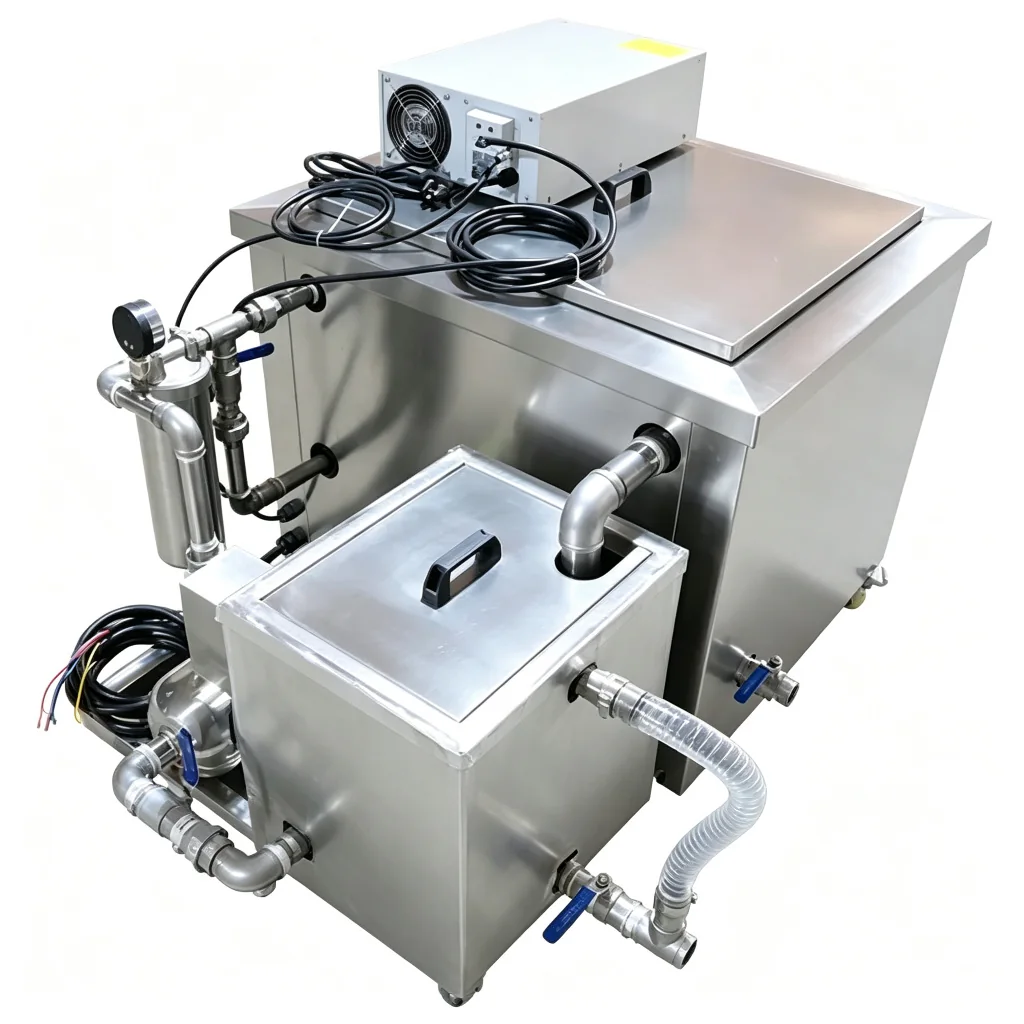
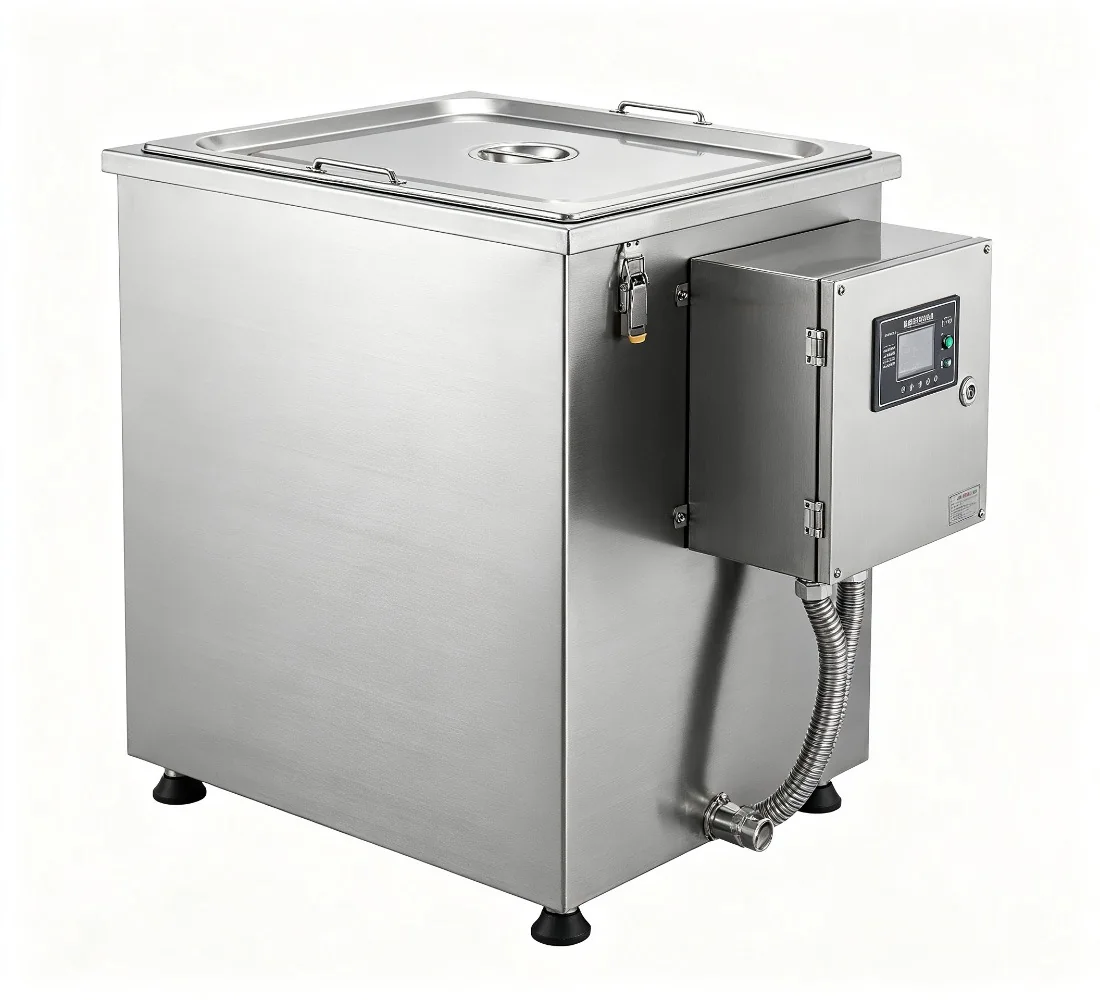
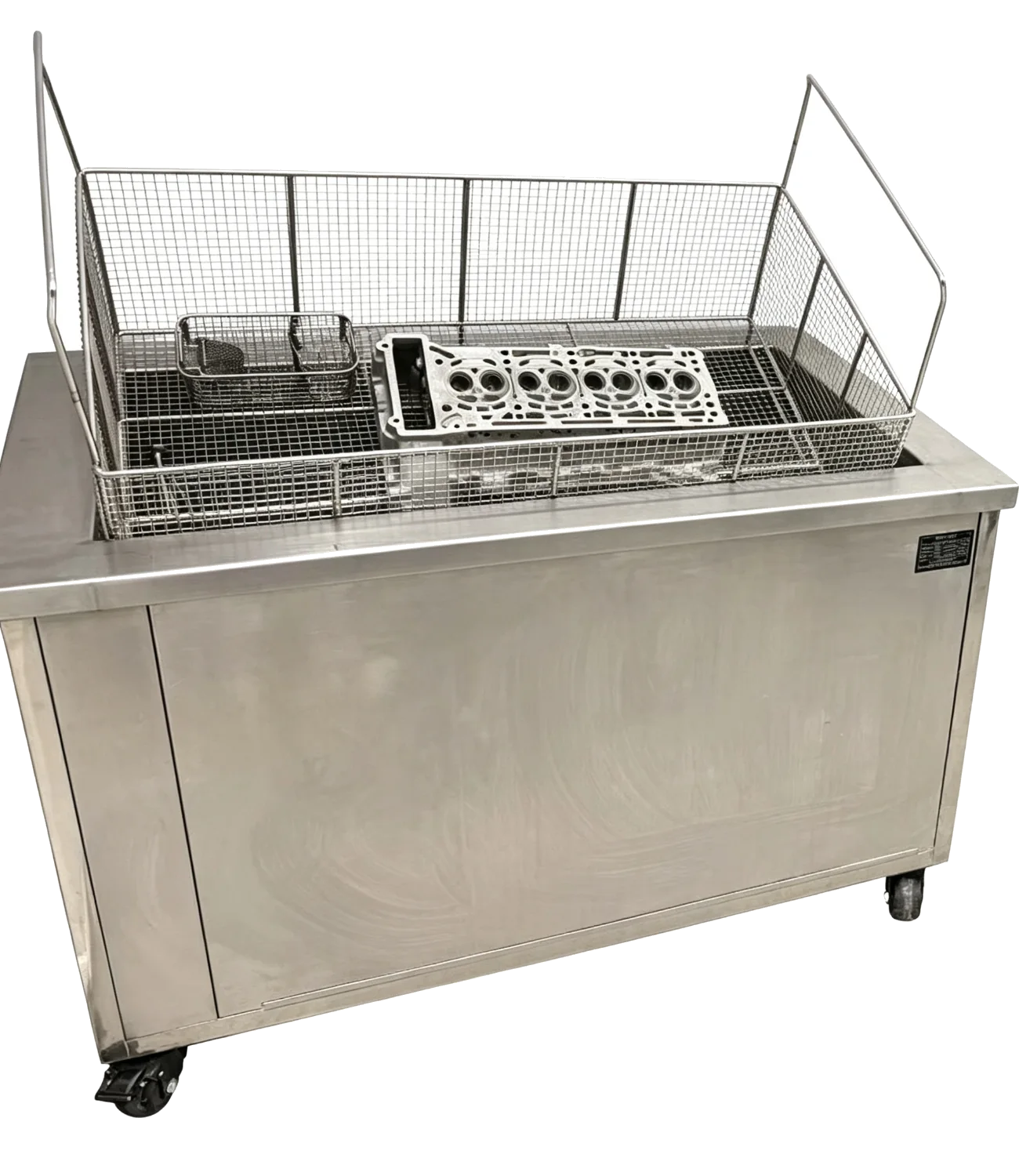
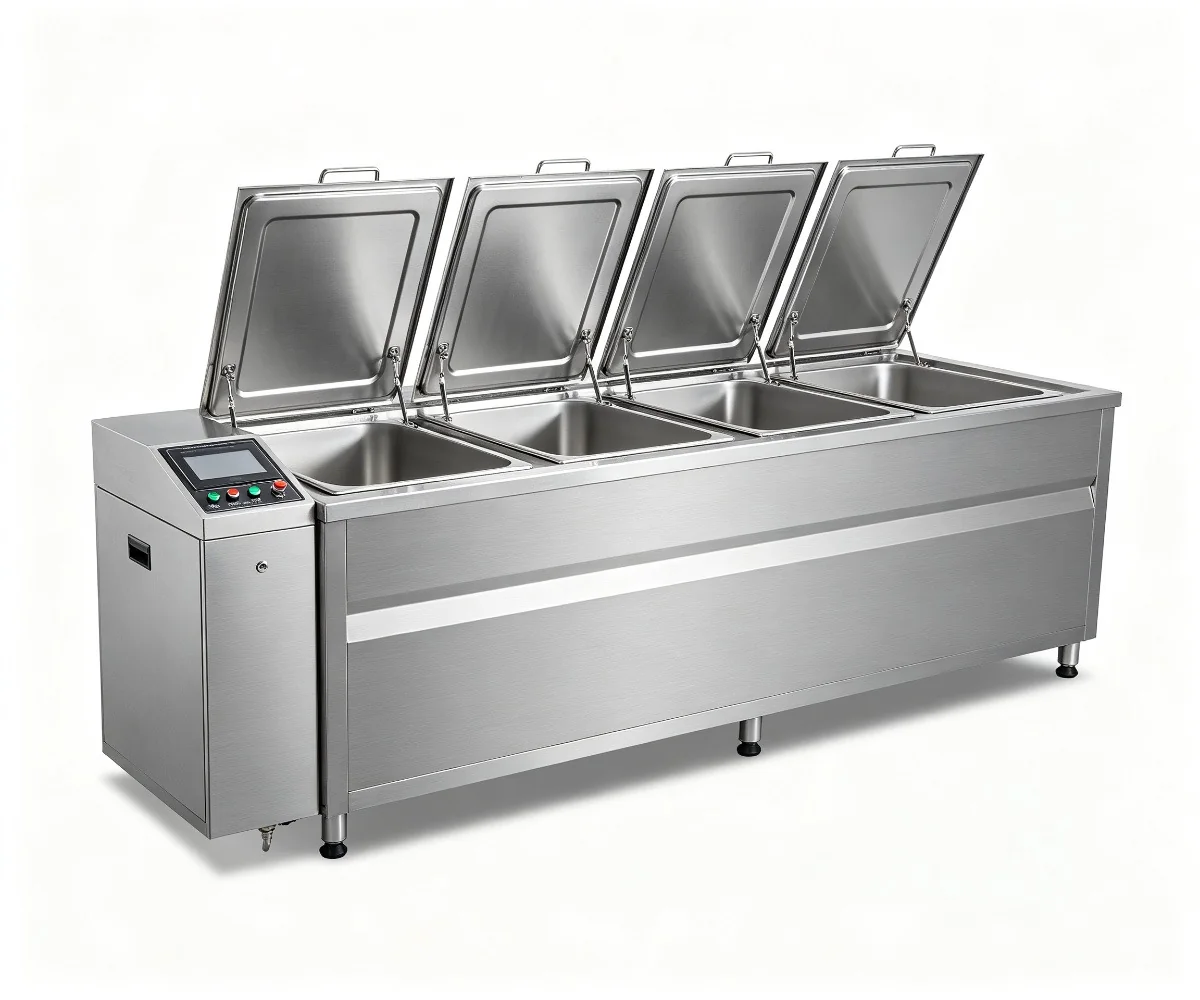
A sealed vacuum ultrasonic cleaner that degreases with hydrocarbon or modified-alcohol solvent and finishes with vacuum drying for blind holes and complex parts.
Move the pointer over the main image to inspect details.
Industrial Single-Tank & Special Cleaners
Vacuum Solvent Ultrasonic Cleaning Machine
Sealed vacuum ultrasonic cleaning and drying with hydrocarbon or modified-alcohol solvent
The vacuum ultrasonic cleaner is a sealed, engineered system that applies ultrasound under reduced pressure with hydrocarbon solvent or modified alcohol. Lowering the boiling point and removing air from the chamber lets the solvent penetrate blind holes, capillary gaps and dense stacked parts, while a vacuum drying stage removes solvent vapour without water marks.
Construction, controls and process options for this equipment.
01
Industrial Single-Tank & Special Cleaners
Vacuum Solvent Ultrasonic Cleaning Machine
01
Vacuum ultrasonic wash
Ultrasound under reduced pressure drives solvent into blind holes and stacked parts.
02
Solvent vapor stage
A vapor zone dissolves residual oil and supports a clean final rinse.
03
Vacuum drying
Boiling solvent under vacuum dries complex cavities without water marks.
04
Distillation recovery
A distillation loop separates oil from solvent to recover clean solvent.
05
Sealed explosion-proof chamber
A pressure-rated sealed chamber with inerting and safety controls for flammable media.
06
Automatic program cycle
PLC sequences evacuation, immersion, vapor and drying stages automatically.
07
Oil removal
Contaminated oil is concentrated and discharged from the distillation stage.
08
Low solvent consumption
A closed recovery loop keeps solvent loss and emissions low.
Model
Chamber (L)
Frequency
Vacuum Stage
Typical Load
Cycle
LJ-V120
120
28 KHz
Wash + vapor + dry
Small precision parts
15-25 min
LJ-V200
200
28 KHz
Wash + vapor + dry
Bearings and gears
18-30 min
LJ-V300
300
28 KHz
Multi wash + vapor + dry
Aerospace components
20-35 min
LJ-V500
500
28 KHz
Multi wash + vapor + dry
Baskets of machined parts
25-40 min
Vacuum levels, solvent compatibility, chamber volume and multi-chamber configurations are engineered to order. Systems include safety, inerting and recovery modules.
Applications
Typical applications
Common workpieces, contamination types and process uses for this vacuum ultrasonic cleaner.
01
Vacuum Solvent Ultrasonic Cleaning Machine
Batch and process applications for the equipment.
01
Aerospace components
Removes machining and preservative oil from tight-tolerance parts.
02
Bearings and gears
Vacuum penetration and drying protect assembled precision parts.
03
Fuel system components
Degreases small holes and fuel accessories without residue.
04
Sintered parts
Removes oil from porous sintered metal before assembly.
05
Fine blanked parts
Lifts drawing oil from stacked precision parts.
06
Turned precision parts
Dries blind holes and threads where air drying fails.
07
Hydraulic and pneumatic parts
Provides a dry, residue-free valve and pump surface.
08
Medical precision parts
Selected compatible solvents support non-aqueous precision cleaning.
09
Small metal assemblies
Cleans and dries assembled components in one cycle.
Configuration Options
Configure the system for your process
Tank dimensions, utilities, automation and process settings are finalized around the application.
Solvent and material compatibility
Chamber and basket sizing
Vacuum and drying requirements
Solvent recovery capacity
Site safety and utilities
Media
Hydrocarbon / modified alcohol
Process
Vacuum wash, vapor, vacuum dry
Chamber
120-500 L standard, custom
Recovery
Solvent distillation loop
Safety
Sealed, inerted, explosion-proof
Product Questions
Before selecting this equipment
Vacuum lowers the solvent boiling point and removes air from the chamber so solvent reaches blind holes and capillary gaps, then vacuum drying removes vapour from those same cavities without leaving water marks.
Both handle flammable media, but a vacuum cleaner is a sealed chamber engineered for reduced-pressure wash, vapor and vacuum drying, whereas an explosion-proof cleaner is rated for open immersion of flammable solvent at atmospheric pressure.
Yes. A distillation stage separates dissolved oil and contamination from the solvent, recovering clean solvent for the next cycle and keeping consumption low.
Related Equipment
Compare the same product family
Review adjacent configurations before fixing the cleaning process.